
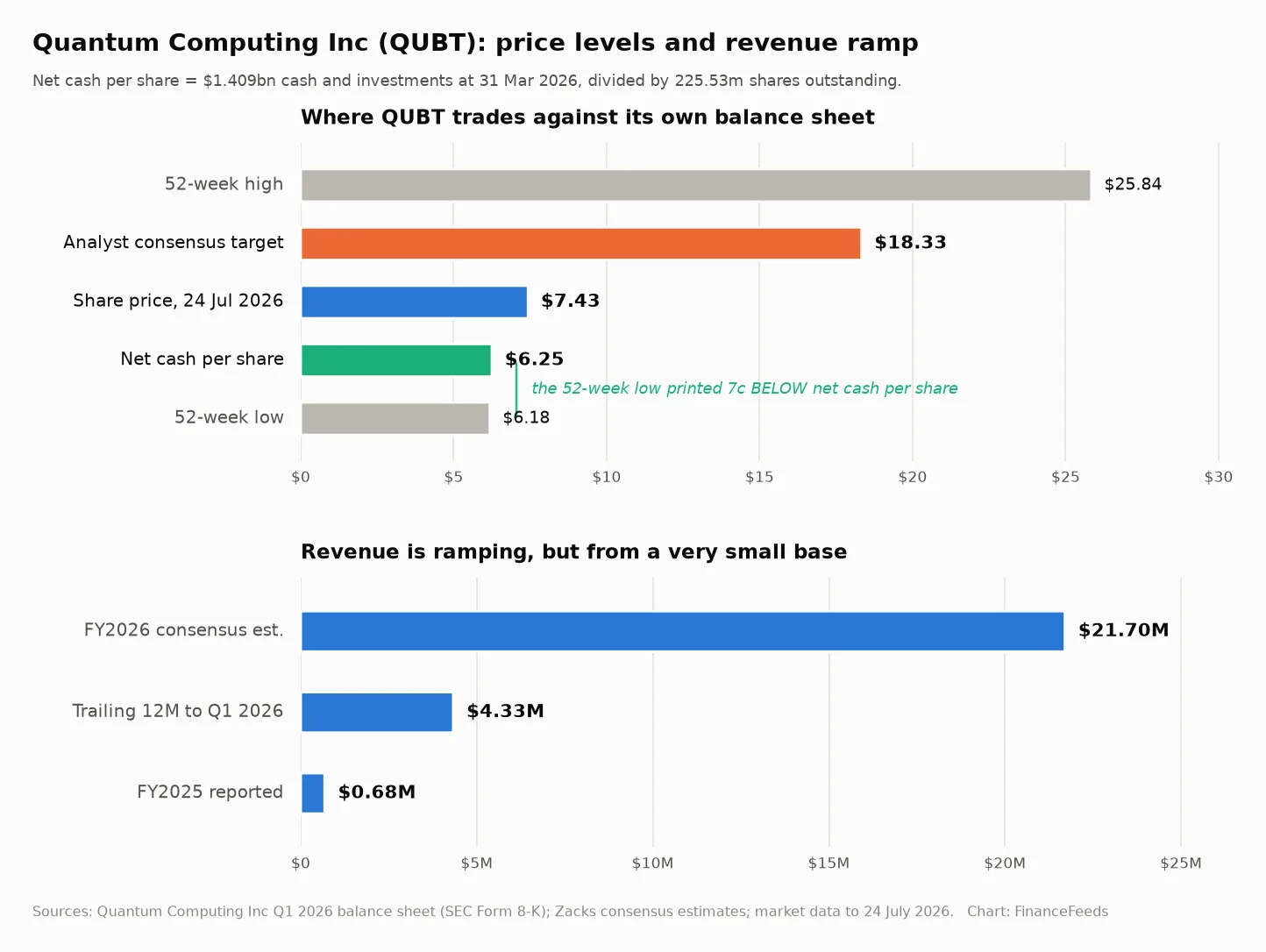
The most common thing said about Quantum Computing Inc is that it is a story stock with no revenue. That is not quite right, and the way it is wrong is the most interesting thing on the balance sheet. QUBT closed at $7.43 on July 24, 2026, giving it a market capitalisation of roughly $1.68 billion. Against that, the company held approximately $1.409 billion in cash and investments at March 31, 2026, with total liabilities of just $23.4 million. That works out to $6.25 of net cash per share across 225.53 million shares outstanding. The stock’s 52-week low of $6.18 therefore printed below the company’s own cash pile. For a brief window this year, the market assigned the entire operating business — the fabs, the photonics portfolio, the acquisitions — a value of less than nothing.
That single fact reframes the whole debate. Most quantum-computing valuation arguments are conducted in the language of total addressable market and decade-long timelines, which is another way of saying they cannot be checked. The cash floor can be checked. It gives QUBT something almost no other speculative quantum name has: an arithmetic downside that does not depend on believing any part of the technology roadmap. The bull case, at the $18.33 average target published by six covering analysts, implies roughly 146.7% upside. The distance down to the cash line is about 15.9%. That asymmetry — not the science — is the actual investment argument, and it is why the stock behaves the way it does. Whether the asymmetry is real depends on one question this article works through: how fast is the cash burning, and is it buying anything.
Key facts
- Share price: $7.43 at the close on July 24, 2026; market capitalisation about $1.68 billion — StockAnalysis
- Cash and investments: approximately $1.409 billion at March 31, 2026 ($257.7m cash, $728.4m short-term investments, $422.8m long-term investments) — Q1 2026 balance sheet, SEC Form 8-K
- Total liabilities: $23.4 million at March 31, 2026, against roughly $1.6 billion of total assets and $1.6 billion of stockholders’ equity — SEC Form 8-K
- Net cash per share: $6.25, versus a 52-week low of $6.18 and a 52-week high of $25.84
- Revenue: $4.33 million trailing twelve months; $682,000 for FY2025, itself up 82.84% year over year — StockAnalysis
- FY2026 consensus revenue: $21.7 million, per the Zacks Consensus Estimate; QUBT carries a Zacks Rank of 2 (Buy)
- Analyst target: $18.33 average across six analysts, implying about 146.7% upside from the July 24 close
- Foundry revenue: a little more than $120,000 in Q1 2026 — four to five times the Q4 2025 figure, but still a rounding error against the market capitalisation
What Quantum Computing Inc actually sells
QUBT is not primarily trying to build the fastest qubit machine. It is trying to become a supplier of the photonic components that quantum and AI hardware need, which is a materially different business with a materially different risk profile. The company provides foundry services for thin-film lithium niobate photonic chips — TFLN — and sells a vertically integrated stack spanning photonic components, subsystems and full systems.
TFLN matters because lithium niobate handles high-speed electro-optic modulation better than silicon, which makes it useful anywhere light needs to be switched quickly: quantum networking, optical interconnects inside AI data centres, secure communications. That last category is the reason a photonics supplier ends up adjacent to the same infrastructure story driving AI data-centre names, rather than sitting purely in the quantum-research bucket.
The honest caveat is scale. On the Q1 2026 call, CEO Dr. Yuping Huang described the company’s progress across two completed acquisitions, Luminar Semiconductor and NuCrypt, and was candid that Fab 1 is intended principally as a research and development facility rather than a volume production line. Foundry-related sales came in at a little more than $120,000 for the quarter. That is a four-to-fivefold increase on Q4 2025 and genuinely a good growth rate — but it is $120,000 against a $1.68 billion market capitalisation. Anyone underwriting QUBT on foundry revenue today is underwriting an intention, not a business.
Huang was similarly direct about the gate-based machine. The engineering constraint, he explained, is raising the quality factor of the microring resonators above 10 million. On where the company currently stands, he said plainly: “Right now, we are at around 2 million.” That is a five-fold improvement still required on a core physical parameter, disclosed by the chief executive rather than dug out by a short seller. It is the clearest single statement of how far the technology has to travel.
The revenue surge is an acquisition story, and that matters
Headlines about QUBT this year have leaned on an enormous growth rate — Q2 2026 is projected to show revenue growth in the region of 7,733%. Percentages that large are always a signal to check the base. FY2025 revenue was $682,000. Growing from a base that small produces spectacular percentages from ordinary dollar amounts.
More importantly, the composition has changed. Q1 2026 revenue was roughly $3.7 million while foundry sales were about $120,000. The gap is largely explained by acquisitions: Luminar Semiconductor and NuCrypt closed in the period, with the NHanced Semiconductors acquisition and a NeuraWave agreement with Planck Dynamics expanding the hardware footprint further. QUBT is buying revenue and capability with the balance sheet, which is a defensible use of a large cash pile — but it means the FY2026 consensus of $21.7 million should be read as a portfolio of acquired businesses plus a small organic photonics operation, not as evidence that the quantum thesis is converting.
This is the distinction that separates QUBT from its listed peers. Rigetti and D-Wave are both selling quantum systems and access directly. QUBT is assembling a components supplier underneath the sector while holding more cash than the operating business currently justifies. Which model is better is genuinely unsettled — but they are not the same trade, and treating the quantum names as interchangeable is the most common analytical error in this sector.
Where the price sits against the balance sheet
The chart below plots the levels that matter and the revenue ramp behind the consensus estimate.
The same figures in table form:
| Level | Value | Versus $7.43 close |
|---|---|---|
| 52-week high | $25.84 | +247.8% |
| Analyst consensus target | $18.33 | +146.7% |
| Share price, July 24, 2026 | $7.43 | — |
| Net cash per share | $6.25 | −15.9% |
| 52-week low | $6.18 | −16.8% |
Strip the cash out and the operating business is being valued at roughly $271 million in enterprise value. Against the $21.7 million FY2026 consensus that is about 12.5 times forward sales — unremarkable for a hardware company with this growth profile, and far below where the quantum names traded at the 2025 peak. Against trailing revenue of $4.33 million it is roughly 62 times, which is expensive. Both numbers are true; which one governs depends entirely on whether the acquired revenue actually lands.
The burn is the offsetting risk. The reported net loss of $39.71 million in the current period, set against $1.409 billion of cash, implies many years of runway at the present rate — but that rate is rising as acquisitions are absorbed, and the company has been enlarging its capital headroom. In early July 2026 QUBT filed a $118.52 million shelf registration covering 13,544,946 shares tied to an employee stock ownership plan, and secured shareholder approval to raise authorised common shares to 450,000,000. Authorised is not issued, and this is normal housekeeping for an acquisitive company. But a share count that could roughly double is the mechanism by which a cash floor stops being a floor, and it deserves to be watched rather than waved away.
The sector round-trip and the policy tailwind
QUBT does not trade on its own news. Quantum equities rallied hard on the June 22, 2026 executive orders and then handed the entire move back within three weeks, with IonQ down 37.6%, Rigetti down 31.5% and D-Wave down 27.7% over a month. QUBT fell about 27.65% over the same window and is down roughly 56.9% over a year. Whatever the individual balance sheets say, these names still move as one basket on policy headlines and risk appetite.
The policy direction is nonetheless real and unusually specific. Washington has ordered federal systems onto post-quantum cryptography by 2031, a mandate that creates dated procurement demand for exactly the secure-communications and photonic-components layer QUBT is positioning around. A deadline in statute is a firmer foundation than a total-addressable-market slide.
The competitive set is also widening quickly, which cuts against every incumbent. Quantinuum, Infleqtion and Xanadu have all recently reached public markets, and Pasqal is pursuing a listing via SPAC merger with Bleichroeder Acquisition Corp II, expected to close in the second half of 2026. More listed quantum names means the sector’s capital is spread thinner. Retail sentiment has noticed: in a widely upvoted r/ValueInvesting thread, one commenter’s summary of the bear case drew 57 upvotes — “The current names will be gone before quantum starts making money.” That is the risk in one line, and it is not an unreasonable one.
The $18.33 bull case
The bull case does not require the gate-based machine to work. It requires three things. First, the acquired businesses deliver the $21.7 million FY2026 consensus, converting QUBT from a pre-revenue story into a real components supplier at roughly 12.5 times forward sales. Second, the post-quantum cryptography mandate begins translating into dated federal orders in the secure-communications layer, where photonic hardware is a requirement rather than an option. Third, the sector’s multiple recovers some of the compression from the post-June round-trip.
On that path, $18.33 is not heroic. It is roughly $12 per share of operating value on top of the $6.25 cash floor — about $2.7 billion of enterprise value against a business the consensus already expects to be growing quickly. Index inclusion helps at the margin: QUBT was added to multiple Russell value and small-cap benchmarks this year, which brings passive demand that does not care about the qubit roadmap.
The $6.25 bear case
The bear case is simply that the cash floor is the fair value, because the operating business does not earn its keep. Foundry revenue of $120,000 a quarter, a microring quality factor at 2 million against the 10 million required, and a loss rate near $40 million in the period together describe a company that is years from commercial relevance in its headline market. If the acquired revenue is lower-margin semiconductor work rather than quantum photonics, the multiple that work deserves is far below 12.5 times sales.
The floor can also move. Every share issued under the enlarged authorisation dilutes cash per share, and every acquisition converts liquid cash into goodwill and intangibles that the market will not underwrite at book. The 52-week low of $6.18 shows the market is willing to test the floor — and a floor that is being spent is a floor that falls.
What happens next
One: the composition of Q2 revenue matters more than the headline. A 7,733% growth rate will be reported and will be meaningless on its own. The number to find is organic foundry and photonics revenue separated from acquired revenue. If foundry moves from $120,000 toward the high six figures, the thesis is converting. If total revenue rises while foundry stalls, QUBT is a semiconductor roll-up wearing a quantum label.
Two: watch the share count, not the cash balance. Cash per share is the entire downside argument. With authorised shares raised to 450 million against 225.53 million outstanding, the relevant disclosure is issuance, not the headline liquidity figure.
Three: expect the sector to keep trading as one. Until quantum names diverge on earnings rather than policy headlines, QUBT’s price will be set substantially by IonQ, Rigetti and D-Wave. A balance-sheet argument is not a short-term catalyst, and investors treating $6.25 as a hard stop should expect it to be tested rather than respected.
Frequently asked questions
What is the QUBT stock price prediction for 2026?
Six covering analysts carry an average target of $18.33, implying roughly 146.7% upside from the July 24, 2026 close of $7.43. QUBT also holds a Zacks Rank of 2 (Buy) on an improving earnings outlook. The realistic downside anchor is net cash of about $6.25 per share, some 15.9% below the current price.
Is QUBT stock a good buy?
The argument in favour is asymmetry: roughly 15.9% down to the cash floor against a consensus target 146.7% higher. The argument against is that foundry revenue was only about $120,000 in Q1 2026 and the company remains heavily lossmaking. It suits investors comfortable with pre-commercial hardware risk. This is analysis, not investment advice.
How much cash does Quantum Computing Inc have?
Approximately $1.409 billion in cash and investments at March 31, 2026 — $257.7 million of cash and equivalents, $728.4 million of short-term investments and $422.8 million of long-term investments — against total liabilities of just $23.4 million. That equals roughly $6.25 per share.
Why did QUBT stock fall so much?
QUBT is down roughly 56.9% over a year and about 27.65% over the past month. The fall is largely sector-wide: quantum equities gave back the entire rally that followed the June 22, 2026 executive orders, with IonQ down 37.6%, Rigetti down 31.5% and D-Wave down 27.7% over a comparable month.
Does QUBT compete with IonQ, Rigetti and D-Wave?
Only partly. Rigetti and D-Wave sell quantum systems and machine access directly. QUBT is positioning as a photonics components and foundry supplier for thin-film lithium niobate chips, serving quantum networking, secure communications and AI interconnects. It is better understood as an arms supplier to the sector than a direct machine competitor.
What does Quantum Computing Inc actually do?
It provides foundry services for thin-film lithium niobate photonic chips and sells a vertically integrated portfolio of photonic components, subsystems and full-stack systems. Its Dirac machines target optimisation workloads, while Fab 1 operates principally as a research and development facility rather than a volume production line.
This article is informational analysis and does not constitute investment advice. Figures are sourced and dated as shown; equity prices move continuously and every quotation is a timestamped snapshot. Pre-commercial hardware companies carry elevated execution, dilution and customer-concentration risk, and cash balances can be spent, invested or converted into illiquid assets. Do your own research before making any investment decision.
{“@context”: “https://schema.org”, “@type”: “FAQPage”, “mainEntity”: [{“@type”: “Question”, “name”: “What is the QUBT stock price prediction for 2026?”, “acceptedAnswer”: {“@type”: “Answer”, “text”: “Six covering analysts carry an average target of $18.33, implying roughly 146.7% upside from the July 24, 2026 close of $7.43. QUBT also holds a Zacks Rank of 2 (Buy) on an improving earnings outlook. The realistic downside anchor is net cash of about $6.25 per share, some 15.9% below the current price.”}}, {“@type”: “Question”, “name”: “Is QUBT stock a good buy?”, “acceptedAnswer”: {“@type”: “Answer”, “text”: “The argument in favour is asymmetry: roughly 15.9% down to the cash floor against a consensus target 146.7% higher. The argument against is that foundry revenue was only about $120,000 in Q1 2026 and the company remains heavily lossmaking. It suits investors comfortable with pre-commercial hardware risk. This is analysis, not investment advice.”}}, {“@type”: “Question”, “name”: “How much cash does Quantum Computing Inc have?”, “acceptedAnswer”: {“@type”: “Answer”, “text”: “Approximately $1.409 billion in cash and investments at March 31, 2026 — $257.7 million of cash and equivalents, $728.4 million of short-term investments and $422.8 million of long-term investments — against total liabilities of just $23.4 million. That equals roughly $6.25 per share.”}}, {“@type”: “Question”, “name”: “Why did QUBT stock fall so much?”, “acceptedAnswer”: {“@type”: “Answer”, “text”: “QUBT is down roughly 56.9% over a year and about 27.65% over the past month. The fall is largely sector-wide: quantum equities gave back the entire rally that followed the June 22, 2026 executive orders, with IonQ down 37.6%, Rigetti down 31.5% and D-Wave down 27.7% over a comparable month.”}}, {“@type”: “Question”, “name”: “Does QUBT compete with IonQ, Rigetti and D-Wave?”, “acceptedAnswer”: {“@type”: “Answer”, “text”: “Only partly. Rigetti and D-Wave sell quantum systems and machine access directly. QUBT is positioning as a photonics components and foundry supplier for thin-film lithium niobate chips, serving quantum networking, secure communications and AI interconnects. It is better understood as an arms supplier to the sector than a direct machine competitor.”}}, {“@type”: “Question”, “name”: “What does Quantum Computing Inc actually do?”, “acceptedAnswer”: {“@type”: “Answer”, “text”: “It provides foundry services for thin-film lithium niobate photonic chips and sells a vertically integrated portfolio of photonic components, subsystems and full-stack systems. Its Dirac machines target optimisation workloads, while Fab 1 operates principally as a research and development facility rather than a volume production line.”}}]}